
Payment Orchestration Platform Guide for High-Risk Merchants
How a payment orchestration platform routes, cascades and fails over across multiple acquirers, what it can and cannot fix for high-risk merchants, and a practical checklist for choosing one.
A payment orchestration platform is a software layer that sits between your checkout and your payment providers. It connects to several acquirers, PSPs and alternative payment methods through one integration, then decides per transaction where each payment goes, what happens when it fails, and how the result is reported back to you.
For a high-risk merchant, that decision layer is the difference between one processor and a processing strategy. It lets you run several merchant accounts in parallel, route each card to the route most likely to approve it, fail over when an acquirer goes down or exits your vertical, and keep your card data portable so you are never locked in. It does not get you approved anywhere, and it does not make a bad ratio good.
This guide covers what orchestration actually does, where it helps high-risk merchants and where it does not, the build vs buy decision, and a practical checklist for evaluating platforms.
What a payment orchestration platform actually does
Strip away the marketing and most platforms do the same five jobs:
- Connect. Pre-built connectors to acquirers, gateways, APMs, fraud tools and 3-D Secure servers, so adding a new provider is configuration, not a new integration project.
- Vault. A PCI DSS-compliant token vault that stores card data independently of any single processor. This is the part people underestimate. If your cards are tokenized inside one PSP, your customer base is effectively owned by that PSP.
- Route. A rules engine that picks a provider for each transaction based on card type, BIN, country, currency, amount, cost and live performance.
- Recover. Retry and cascading logic for soft declines, plus failover when a provider is degraded or offline.
- Report. One normalized view of approvals, declines, costs and disputes across every provider, instead of five dashboards that each define "approval rate" differently.
Some platforms add checkout UI, fraud scoring, network tokenization, dispute management or reconciliation. Useful, but those are extras. The vault, the router and the data are the core.
Orchestration vs gateway vs PSP
The terms overlap, so it helps to be precise:
Layer | What it does | Holds a merchant relationship? | Moves money? |
|---|---|---|---|
Acquirer | Underwrites you, sponsors you into the card schemes, settles funds | Yes | Yes |
PSP / gateway | Technical connection to one or more acquirers, often bundled with acquiring | Usually | Often |
Payment orchestration platform | Connects to many PSPs/acquirers and decides where each transaction goes | Usually not | Usually not |
Most independent orchestrators are pure technology: they never touch your funds and never underwrite you. You still need every merchant account behind them approved on its own merits.
Why high-risk merchants need orchestration more than anyone
A mainstream SaaS company uses orchestration to shave basis points off processing costs. A high-risk merchant uses it to stay in business.
The reasons are structural. High-risk acquirers exit verticals with little notice, card scheme monitoring programs put pressure on every merchant in a portfolio, and cross-border card-not-present traffic declines far more than domestic traffic. We covered the single-point-of-failure problem in depth in our guide to high-risk merchant accounts and multi-MID routing. Orchestration is the layer that makes a multi-MID setup operable in practice:
- Resilience. When one acquirer terminates or goes down, volume moves to routes that are already underwritten and live, instead of your revenue stopping while you apply somewhere new.
- Approval rates. High-risk traffic is where routing gains are largest, because issuer behavior varies more by acquirer, country and descriptor.
- Capacity management. Each merchant account is underwritten for a volume cap. The router keeps each route inside its limits so no acquirer's risk team gets a surprise.
- Negotiating leverage. Once switching providers is a configuration change, pricing and reserve conversations change tone.
- Data ownership. A processor-independent vault means that if a PSP relationship ends, your stored cards and subscriptions do not end with it.
Smart routing, cascading payments and failover explained
These three terms get used interchangeably. They are different mechanisms, and a serious platform supports all three with separate controls.
Smart routing
Smart routing chooses the first route for a transaction. Typical inputs:
- BIN routing. The first six to eight digits of the card identify the issuer, card type (debit, credit, prepaid, commercial) and issuing country. Some acquirers perform much better on certain BIN ranges, and local acquiring (an acquirer in the same country as the issuer) often approves better and costs less than cross-border.
- Currency and geography. Routing a EUR transaction to an acquirer that settles EUR natively avoids an FX conversion and often improves approval.
- Cost. Where approval is comparable, send volume to the cheaper route.
- Performance. Live approval and error rates per route, with rules that shift traffic when a route underperforms its baseline.
- Allocation rules. Volume caps and target splits per merchant account, matching what each acquirer underwrote.
Cascading payments
Cascading is what happens after a soft decline: the platform retries the same transaction on a different route. Done properly, it recovers revenue from declines caused by the route rather than the cardholder, such as an acquirer-side technical error, an issuer that dislikes a particular cross-border route, or a 3-D Secure requirement that can be satisfied on the next attempt.
Done badly, it is exactly what card schemes penalize. Visa classifies decline codes into categories, and Category 1 responses (the issuer will never approve, for example a closed or invalid account) must never be resubmitted. Mastercard's Merchant Advice Codes work similarly: MAC 03 means "do not try again." Both schemes cap reattempts on soft declines and charge fees for excessive retries, and the limits and fee levels are set in their rules and updated periodically. A good platform:
- Reads the decline code and merchant advice code before deciding whether to cascade.
- Never retries hard declines on another route.
- Caps attempts per card and per transaction.
- Logs every attempt, so you can prove your retry behavior to an acquirer if asked.
Cycling a declined card across every merchant account you have until one approves is not optimization. It is one of the patterns acquirers and schemes actively look for.
Failover
Failover is infrastructure-level: when a provider times out, returns errors, or is unreachable, traffic is drained from it automatically and sent elsewhere. Unlike cascading, it is triggered by provider health, not by an individual decline. Ask vendors how quickly failover triggers, whether it is automatic or manual, and whether it handles partial outages (for example, one acquirer failing only on 3-D Secure).
Approval rate optimization: what orchestration can and cannot fix
Orchestration can realistically improve approvals by:
- Matching BINs and countries to the routes that perform best for them.
- Using local acquiring where you have it.
- Recovering route-caused soft declines through compliant cascading.
- Supporting network tokens (Visa Token Service, Mastercard Digital Enablement Service), which keep stored credentials updated when cards are reissued and are generally viewed favorably by issuers.
- Handling 3-D Secure intelligently: applying it where it is required or helps, exempting where it is allowed and safe, and retrying with authentication when an issuer responds that strong customer authentication is required.
- Sending clean, consistent data (correct MCC, descriptor, AVS, CVV, recurring-transaction flags) on every route.
Orchestration cannot fix:
- A product or billing model that generates disputes. If your ratios are high, routing spreads the same problem across more acquirers, each of which can see it. Read our breakdown of Visa VAMP and Mastercard chargeback thresholds for how monitoring works in 2026.
- Fraud. Better routing of stolen cards means more approved fraud and more chargebacks.
- Underwriting. No platform gets you a merchant account. If you have been terminated and listed, see how MATCH listings and removal work before you do anything else.
Be skeptical of any vendor quoting a specific uplift ("+15% approvals") without showing you the baseline, the traffic mix and the measurement method. Real gains depend entirely on your starting point, your providers and your customer base.
The compliance line: orchestration vs MID stacking
Orchestration is a legitimate tool, and it can also be misused. The misuse has names: MID stacking, load balancing to hide ratios, and transaction laundering. The pattern is spreading one business across many thinly underwritten accounts, sometimes under different entities or websites, so that no single acquirer sees the real chargeback or fraud ratio.
It is prohibited under card scheme rules, acquirers share data and monitor for it, and it tends to end with terminations across every account, MATCH listings for the business and its principals, and funds held for months. Scheme programs also look at acquirer portfolios, not just single merchants, so the idea that ratios can be hidden indefinitely is wrong.
Legitimate orchestration looks like this:
- Every merchant account is underwritten for the real business, products and website.
- Each acquirer knows you use more than one processor.
- Allocation follows performance, cost and underwritten capacity, not monitoring thresholds.
- Disputes are reduced at the source: clear descriptors, dispute-prevention alerts, refunds, honest billing.
If a vendor or "consultant" pitches routing as a way to stay under monitoring thresholds, walk away.
Build vs buy
Some large merchants build their own orchestration. For most high-risk businesses, buying is the rational choice, but the trade-offs are worth understanding.
Factor | Build in-house | Buy a platform |
|---|---|---|
Time to first route | Months per provider integration | Weeks, if connectors exist |
PCI DSS scope | You run a card data environment and carry full assessment scope | Vault is the vendor's; your scope can shrink significantly |
Control over logic | Total | Limited to what the rules engine exposes |
Ongoing maintenance | Every API change, scheme mandate and 3DS update is yours | Vendor maintains connectors |
Cost profile | Engineering salaries plus compliance | Platform fee, often per transaction or tiered |
Key risk | Under-resourced team, compliance gaps | Vendor lock-in, missing connectors |
Building usually only makes sense when you have high volume, a strong in-house payments engineering team, and routing requirements no vendor supports. Keep in mind that current PCI DSS (v4.0.1) includes e-commerce requirements on payment page script integrity and tamper detection that became mandatory after 31 March 2025, so running your own card data environment is a meaningful ongoing commitment.
A middle path is common: buy the vault and connectors, and keep business-specific routing logic in your own system via the platform's API.
How to evaluate a payment orchestration platform: a checklist
The market includes independent orchestrators (names you will come across include Spreedly, Primer, Gr4vy, IXOPAY, Yuno and Corefy), orchestration features offered by PSPs and acquirers, and white-label platforms aimed at PSPs. They differ a lot in who they serve. Work through the list below with each shortlisted vendor, ideally against your own traffic data.
Connectors and coverage
- Does it already connect to the acquirers and PSPs that actually board your vertical? A catalog of hundreds of connectors means nothing if your two high-risk acquirers are missing.
- How long does a new connector take, who pays for it, and who maintains it?
- Does it support the APMs your markets use (local cards, bank transfers, wallets)?
- Is the platform comfortable with your MCC and vertical? Some vendors' own terms or banking partners exclude certain high-risk categories. Ask directly.
Vault and data portability
- Is the vault PCI DSS Level 1, and can you see the current Attestation of Compliance?
- Can you export your card data to another PCI-compliant party if you leave? Get the process and any fees in writing. This is the single most important lock-in question.
- Does it support network tokens and account updater services?
Routing engine
- Which fields can rules use: BIN, issuer country, card type, currency, amount, MCC, customer segment, time, route health?
- Can you set volume caps and percentage splits per merchant account?
- Can non-engineers change rules safely, with versioning and rollback?
- Does it support A/B testing of routes with statistically meaningful reporting?
Cascading and retries
- Does cascading read decline codes and merchant advice codes, and block hard-decline retries by default?
- Can you configure attempt limits per card and per transaction?
- Is every attempt logged with the full response data?
Failover
- Automatic or manual? What is the detection window?
- Does it handle partial outages (one currency, one card brand, 3DS only)?
3-D Secure and SCA
- Does it include a 3DS server or integrate with yours?
- Can it run 3DS once and send the authentication result to whichever acquirer processes the payment? Not every acquirer accepts third-party authentication data, so confirm with each one.
- How does it manage exemptions and SCA soft-decline retries for EEA and UK traffic?
Reporting and reconciliation
- Normalized approval, decline and cost reporting across providers, broken down by BIN, country and route.
- Dispute and fraud data per merchant account, so you can see your ratios the way each acquirer sees them.
- Settlement reconciliation, or at least clean exports your finance team can reconcile.
Commercials and vendor risk
- Pricing model: per transaction, percentage, tiered or flat, and what counts as a billable transaction (do retries and cascades count?).
- Contract term, exit terms and data export obligations.
- Who owns the vendor? An orchestrator owned by a PSP or acquirer may have different incentives about where your volume goes than an independent one.
- Uptime SLA, support hours in your time zones, and incident history.
- Financial stability. Your checkout depends on this company staying in business.
Implementation: how to roll it out without breaking checkout
- Baseline first. Capture at least a few months of approval rates, decline codes and costs per provider, broken down by BIN country and card type. Without a baseline, you cannot measure anything the platform does.
- Migrate the vault. Move stored cards from your current PSP to the orchestration vault through a PCI-compliant export. Plan this carefully for subscriptions, since a failed migration shows up as failed renewals.
- Start with one route behind the platform. Put your current processor behind the orchestration layer before adding anything new, so you can confirm parity.
- Add a second route and a simple rule. For example, failover only. Then introduce BIN or country routing on a small share of traffic.
- Enable cascading last, with conservative attempt limits and hard-decline blocks, and review the logs weekly.
- Review monthly with each acquirer. Share your volumes and ratios per account. Transparency is what keeps multi-acquirer setups stable.
If your business model is still being decided, it is also worth reading merchant of record vs payment facilitator before building routing around your own merchant accounts. For some digital businesses, an MoR is the simpler answer.
How Actionman helps
We design processing structures for high-risk and cross-border merchants: which acquirers fit your vertical, how many routes you need, which orchestration setup suits your volume and team, and how settlement flows into banking you control. Every account we help arrange is underwritten for the real business. If you are weighing platforms or building your first multi-acquirer setup, contact us with your vertical, monthly volume and markets.
Frequently asked questions
Does a payment orchestration platform replace my payment processor?
No. An orchestration platform sits on top of your processors and acquirers and decides which one handles each transaction. You still need at least one underwritten merchant account behind it, and for resilience you usually want two or more.
Can a payment orchestration platform get a high-risk business approved for processing?
No. Orchestrators are technology providers and generally do not underwrite merchants. Each acquirer behind the platform approves you on its own criteria, and some orchestrators restrict certain high-risk categories themselves, so confirm your vertical is accepted before you sign.
How much does a payment orchestration platform cost?
Pricing models vary: per-transaction fees, a percentage of volume, tiered monthly plans or flat enterprise contracts. Ask whether retries and cascaded attempts are billed as separate transactions and whether there are fees for connectors or for exporting your card data if you leave.
Is cascading payments allowed under Visa and Mastercard rules?
Retrying soft declines on another route is permitted within scheme limits, but hard declines such as Visa Category 1 responses or a Mastercard 'do not try again' advice code must not be retried. Both schemes cap reattempts and charge fees for excessive retries, so cascading logic should read decline codes and enforce attempt limits.
Will orchestration reduce my PCI DSS compliance burden?
Often, yes. If card data is captured and stored in the orchestrator's PCI DSS Level 1 vault rather than your own systems, your own assessment scope can shrink considerably. You still have obligations for your checkout pages, including the script-integrity requirements that became mandatory under PCI DSS v4.0.1 after March 2025.
Sources
- corefy.com · payment orchestration platform guide
- paymentsdive.com · 745101
- history.paypal.com · avoid excessive retries penalties
- blog.pcisecuritystandards.org · coffee with the council podcast guidance for pci dss e commerce requ…
- usa.visa.com · visa payment facilitator model
Rails open. Rails close. Know first.
One short email when something actually changes in banking, processing or crypto liquidity. Written by operators, for operators. No fluff, no spam, unsubscribe in one click.
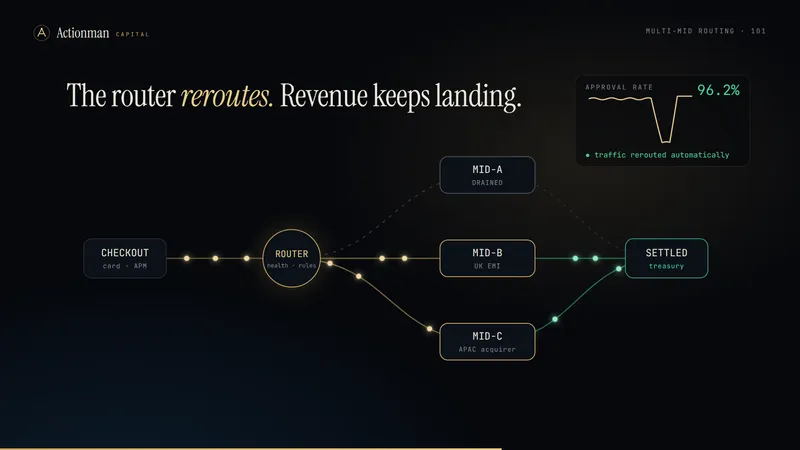
High-Risk Merchant Accounts: How Multi-MID Routing Keeps You Processing
A high-risk merchant account is one decision away from zero. How multi-MID routing and failover work, the 2026 VAMP and retry rules a router must respect, why setups still fail, and where resilience ends and MID stacking begins.
Chargeback Ratio Thresholds: Visa VAMP and Mastercard Rules for 2026
Visa's VAMP threshold dropped to 1.5% in April 2026, and Mastercard still flags merchants at 100 chargebacks and 1.5%. How each ratio is calculated, what it costs, and how to bring it down legitimately.
Merchant of Record vs Payment Facilitator: Liability, Tax and Fit
A merchant of record takes over the sale, including chargebacks and VAT; a payment facilitator only takes over the plumbing. How MoR, PayFac and direct merchant accounts compare, and when each fits.