
Chargeback Ratio Thresholds: Visa VAMP and Mastercard Rules for 2026
Visa's VAMP threshold dropped to 1.5% in April 2026, and Mastercard still flags merchants at 100 chargebacks and 1.5%. How each ratio is calculated, what it costs, and how to bring it down legitimately.
Chargeback ratio thresholds are the numbers that decide whether your acquirer keeps processing for you. Cross them and you enter a card scheme monitoring program: per-dispute fees, remediation plans, and eventually termination.
As of 2026, the two numbers that matter most are these. Visa's VAMP ratio flags a merchant as "Excessive" at 1.5% in the US, Canada, Europe and Asia-Pacific (lowered from 2.2% on April 1, 2026), and that ratio counts fraud reports plus disputes against settled card-not-present transactions. Mastercard's Excessive Chargeback Program flags a merchant at 100 chargebacks and a 1.5% chargeback-to-transaction ratio in a month, rising to a high-excessive tier at 300 chargebacks and 3%.
Most merchants don't get hurt by the headline numbers. They get hurt by how the ratios are calculated: what goes in the numerator, which month sits in the denominator, and where the minimum counts kick in. This guide covers both schemes in detail, then explains how to lower your chargeback ratio legitimately.
Chargeback ratio thresholds at a glance (as of 2026)
Program | Who is measured | Trigger | Minimum count | Main consequence |
|---|---|---|---|---|
Visa VAMP, merchant "Excessive" (US, Canada, EU, AP) | Merchant | VAMP ratio ≥ 1.5% | 1,500 fraud reports + disputes per month | USD 8 per fraud report or dispute, remediation |
Visa VAMP, merchant "Excessive" (Latin America) | Merchant | VAMP ratio ≥ 1.5% | 1,500 per month | Same as above |
Visa VAMP, merchant "Excessive" (CEMEA) | Merchant | VAMP ratio ≥ 2.2% | Lower count floor plus a USD 75,000 value floor | Same as above |
Visa VAMP, acquirer "Above Standard" | Acquirer portfolio | VAMP ratio ≥ 0.5% | 1,500 per month | USD 4 per fraud report or dispute |
Visa VAMP, acquirer "Excessive" | Acquirer portfolio | VAMP ratio ≥ 0.7% | 1,500 per month | USD 8 per fraud report or dispute |
Visa VAMP, enumeration | Merchant | ≥ 20% of authorizations are enumeration | 300,000 enumerated transactions per month | Enrollment and fees |
Mastercard ECM | Merchant | CTR ≥ 1.5% | 100 chargebacks per month | Escalating monthly assessments |
Mastercard HECM | Merchant | CTR ≥ 3.0% | 300 chargebacks per month | Higher assessments plus issuer recovery |
Mastercard EFM | Merchant (e-commerce) | Fraud chargebacks ≥ 0.50% of volume | USD 50,000 fraud, 1,000 e-com transactions, low 3DS use | Escalating monthly assessments |
Fees and minimums above come from Visa's published VAMP fact sheet and acquirer notices. Your acquirer may apply stricter internal limits and pass scheme fees through with a markup, so read your merchant agreement, not just the scheme rules.
How the Visa Acquirer Monitoring Program works
Visa launched the Visa Acquirer Monitoring Program (VAMP) in 2025, replacing the old Visa Dispute Monitoring Program (VDMP) and Visa Fraud Monitoring Program (VFMP). The change that matters: fraud and disputes are no longer measured separately. They are added together into a single ratio.
The VAMP ratio formula
Visa defines the VAMP ratio as:
(Count of fraud reports (TC40) + count of disputes (TC15)) ÷ count of settled transactions (TC05)
A few details change how that plays out in practice:
- Card-not-present only. VAMP looks at card-absent transactions. Your in-store volume doesn't dilute your e-commerce ratio.
- It's a count, not a dollar amount. One disputed USD 4 subscription weighs the same as one disputed USD 4,000 order.
- TC40 fraud reports count even without a chargeback. Issuers file a TC40 when a cardholder reports fraud, whether or not a dispute follows. Processor guidance is that a fraud report that later becomes a dispute generally counts in both buckets.
- Some resolutions are excluded. Disputes resolved through Visa's pre-dispute tools, such as Rapid Dispute Resolution (RDR), are excluded, and TC40s that qualify under Compelling Evidence 3.0 are excluded. That exclusion is the main reason those tools are now worth the cost.
Merchant thresholds and effective dates
VAMP started with an advisory period from April to September 2025, with enforcement fees from October 2025. As of 2026:
- US, Canada, Europe and Asia-Pacific: Excessive at a VAMP ratio of 1.5% or more, effective April 1, 2026 (it was 2.2% until March 31, 2026). A merchant has to have at least 1,500 combined fraud reports and disputes in the month to be measured.
- Latin America and the Caribbean: 1.5% since launch.
- CEMEA (which includes the Middle East and Africa): 2.2%, with a much lower count floor paired with a USD 75,000 value floor. Sources differ slightly on the exact CEMEA count floor, so confirm the current figure with your acquirer.
Visa gives a grace period of three months for a merchant's first identification in a rolling 12-month period. After that, fees apply.
Acquirer thresholds, and why they matter more than yours
This is the part most merchants underestimate. Visa also scores the acquirer's entire portfolio: Above Standard at 0.5% (enforced from January 1, 2026) and Excessive at 0.7%. Those limits are far tighter than any individual merchant's.
An acquirer sitting close to 0.5% can't afford to carry a merchant at 1.2%, even though that merchant is technically below the 1.5% merchant threshold. Expect acquirers to set internal limits well under the scheme numbers, ask for reserves, or exit whole verticals that drag their portfolio ratio up. If you're being told your ratio is a problem while you're "under the limit," this is usually why.
The enumeration ratio
VAMP also tracks card testing. The enumeration ratio is enumerated authorization attempts (approved and declined) divided by all authorization attempts. A merchant is flagged at 20% or more, with a minimum of 300,000 enumerated transactions a month.
That's a high floor, but bot-driven card-testing attacks reach it quickly on an unprotected checkout. Rate limiting, bot detection, CAPTCHA on repeated failures and velocity rules on the payment page are the fixes.
VAMP fees
According to acquirer notices on the program (as of 2026):
- Merchant Excessive: USD 8 per disputed or fraud-reported transaction
- Acquirer Above Standard: USD 4 per disputed or fraud-reported transaction
- Acquirer Excessive: USD 8 per disputed or fraud-reported transaction
Older articles quote USD 10 per dispute and a 0.9% merchant threshold. Those figures came from Visa's earlier proposal and don't match the program as published.
Mastercard's Excessive Chargeback Program (ECM and HECM)
Mastercard's Excessive Chargeback Program (ECP) has two tiers, and both conditions in a tier must be met in the same month:
- Excessive Chargeback Merchant (ECM): at least 100 chargebacks and a chargeback-to-transaction ratio (CTR) of 1.5% to 2.99%
- High Excessive Chargeback Merchant (HECM): at least 300 chargebacks and a CTR of 3% or more
The prior-month denominator
Mastercard's CTR uses a lagged denominator: chargebacks received this month ÷ sales transactions from the previous month.
This catches merchants out when volume drops. Say you processed 20,000 Mastercard transactions in May and 10,000 in June. Chargebacks from May's sales arrive in June and July. June's ratio uses May's healthy volume, but July's ratio divides July's chargebacks by June's lower number. A seasonal dip, a lost traffic source or a paused campaign can push you over 1.5% without any change in customer behavior.
Unlike VAMP, the Mastercard program counts chargebacks across card-present and card-not-present sales.
Assessments and exit
Mastercard's assessments escalate with the number of months in the program. Published acquirer guides show ECM assessments starting at USD 1,000 in the second month and climbing to USD 100,000 per month after 19 months. HECM escalates faster, up to USD 200,000 per month, and adds an issuer recovery assessment of USD 5 per chargeback above 300 once a merchant has been in the program for several months.
To exit, a merchant needs three consecutive months below the threshold. One bad month resets the count.
Excessive Fraud Merchant (EFM)
The Excessive Fraud Merchant program is Mastercard's fraud-to-sales measure for e-commerce. A merchant is enrolled only when all four conditions are met in the same month:
- At least 1,000 e-commerce transactions in the prior month
- At least USD 50,000 in fraud chargebacks
- A fraud-to-sales ratio of 0.50% (50 basis points) or more
- Low use of 3-D Secure: below 10% of e-commerce transactions in markets without a strong customer authentication mandate, or below 50% in regulated markets
That fourth condition is the practical escape route. A merchant that runs a sensible share of traffic through 3-D Secure generally can't be enrolled in EFM, which is one more reason to treat 3DS as a ratio tool rather than just a conversion cost.
A newer Mastercard program to watch
Mastercard's Scam Merchant Monitoring Program, published in 2025, moved to full enforcement on July 24, 2026. It doesn't use a chargeback ratio. It reacts to scam signals, such as sudden collapses in approval rates, issuer reports of cardholder manipulation, and high combined refund and chargeback rates on newer merchants. Consequences can be immediate. Subscription and high-ticket digital merchants should ask their acquirer how it's being applied to their portfolio.
Visa VAMP vs Mastercard ECP: the differences that matter
| Visa VAMP | Mastercard ECP |
|---|---|---|
What's counted | Fraud reports (TC40) + disputes (TC15) | Chargebacks only (fraud measured separately in EFM) |
Transaction scope | Card-not-present | All transactions |
Denominator | Settled transactions, same month | Sales transactions, previous month |
Merchant threshold | 1.5% (2.2% in CEMEA) | 1.5% ECM, 3% HECM |
Minimum count | 1,500 (lower in CEMEA) | 100 ECM, 300 HECM |
Acquirer-level threshold | Yes, 0.5% and 0.7% | Not a direct equivalent |
Relief tools | RDR and CE 3.0 exclusions | 3DS use (for EFM), alerts that prevent chargebacks |
The practical takeaway is that the same business can look very different to each scheme. A merchant with low chargebacks but lots of issuer fraud reports is safe under Mastercard's ECM and exposed under VAMP. A merchant with a volume drop is fine under VAMP's same-month denominator and exposed under Mastercard's lagged one. Track both, separately, every month.
How to calculate your own dispute ratio
Don't wait for your acquirer to tell you. Build a monthly report per card scheme, per MID:
- Pull settled card-not-present transaction counts for Visa for the month.
- Pull Visa TC40 counts (your processor or an alert provider can usually supply them) and TC15 dispute counts, then remove disputes resolved through RDR.
- Calculate the VAMP ratio and compare it with your region's threshold and your acquirer's internal limit.
- Pull Mastercard chargebacks received this month and sales transactions from last month, then calculate the CTR.
- Pull Mastercard fraud chargeback dollar value, e-commerce volume and your 3DS share for the EFM test.
- Trend it. A rolling three-month view shows trouble a month or two before it arrives.
If you run more than one merchant account, report each one on its own. Schemes measure at the merchant level, and so should you. (For how legitimate multi-acquirer setups are structured, see our guide to high-risk merchant accounts and multi-MID routing.)
How to lower your chargeback ratio
There are only two honest ways to improve a ratio: fewer fraud reports and disputes, or disputes resolved before they count. Everything else is noise.
Stop disputes before they're filed
- A recognizable billing descriptor with your brand and a support phone number or URL. "I don't recognize this charge" is the most preventable dispute there is.
- Visible, fast refunds. A refund costs you the sale. A dispute costs the sale, a fee, and ratio headroom.
- Clear subscription terms, renewal reminders and one-click cancellation. Continuity billing without these is the biggest single source of disputes in high-risk verticals.
- Order Insight and similar data-sharing tools that let issuers show cardholders transaction details before they file.
Resolve disputes so they don't count
- Rapid Dispute Resolution (RDR). Pre-set rules auto-refund eligible Visa disputes, and those disputes are excluded from the VAMP ratio. The TC40 fraud report, if one was filed, can still count.
- Compelling Evidence 3.0. For qualifying fraud disputes, matching prior undisputed transactions (same device, IP or account) can exclude the TC40 as well.
- Chargeback alerts (such as Ethoca for Mastercard) notify you when a cardholder contacts their bank, so you can refund before a chargeback is raised. They cost money per alert, whether you refund or not.
Cut fraud at the source
- Fraud screening tuned to your traffic, not a vendor's default rules.
- 3-D Secure applied by risk. It shifts liability for authenticated fraud and, for Mastercard, keeps you out of EFM.
- Card-testing controls: bot detection, rate limits and velocity checks, which protect your VAMP enumeration ratio too.
Better routing also helps approval rates and reduces false declines that turn into "I paid twice" disputes. Our piece on payment orchestration for high-risk merchants goes into the routing side.
What doesn't work: diluting ratios across MIDs
Some operators try to manage the ratio instead of the disputes: spreading one business across several thinly underwritten merchant accounts so no single MID crosses a threshold, splitting transactions to inflate counts, or running "clean" volume through one MID to dilute a bad one. This is often called MID stacking or load balancing.
It's prohibited under card scheme rules, and it's the fastest route to a worse outcome. Schemes and acquirers link merchants by owners, websites, descriptors, devices and card data. When the pattern is found, it doesn't end in one monitoring program. It ends in terminations across every account, funds held in reserve, and often a listing on Mastercard's terminated merchant file. Our guide to the MATCH list and how removal works explains why that listing is so hard to undo.
What happens if you're already in a program
If your acquirer tells you you've been identified:
- Get the numbers. Ask for the month, the scheme, the tier, the counts and the ratio they used. Reconcile it with your own data.
- Find the source. Break disputes down by reason code, product, traffic source, country and BIN. Most problems are concentrated.
- Write a remediation plan with dated actions: descriptor changes, RDR and alerts enrollment, 3DS rules, subscription flow fixes, fraud rules. Acquirers want to see a plan in the first month, not the third.
- Report monthly until you're out. Under Mastercard's program, that means three clean months in a row.
- Protect your treasury. Expect a higher reserve while you're enrolled. Keep enough working capital and settlement redundancy that a reserve increase doesn't stop the business. The same logic applies to your banking: see why business bank accounts get frozen for the settlement side of the risk.
Moving to a new acquirer mid-program to "reset" your ratio rarely works. Applications ask for processing history, and a history showing program enrollment followed by a switch reads worse than a documented remediation.
How Actionman helps
We help high-risk and cross-border merchants set up acquirer relationships that are fully underwritten for the real business, with reporting that tracks VAMP and Mastercard ratios per MID before an acquirer raises them. Where ratios are already a problem, we work with your team on the remediation plan and the conversation with the acquirer. If you want a second view on your numbers, get in touch.
Frequently asked questions
What is a good chargeback ratio?
Staying well below the scheme thresholds is the goal, because acquirers set tighter internal limits than Visa or Mastercard. Visa scores acquirer portfolios at 0.5% and 0.7%, so many acquirers get uncomfortable long before a merchant reaches the 1.5% merchant threshold. Ask your acquirer what internal limit applies to your account and manage to that.
Does a refund count toward the VAMP ratio?
A refund issued before a dispute is filed doesn't create a TC15 dispute, so it doesn't count as one. But if the issuer already filed a TC40 fraud report, that report can still count toward the VAMP ratio. Disputes resolved through Visa's Rapid Dispute Resolution are excluded from the dispute count.
Do small merchants have to worry about VAMP?
Visa only formally measures a merchant against the VAMP threshold once it has at least 1,500 combined fraud reports and disputes in a month in most regions, and a lower count plus a USD 75,000 value floor in CEMEA. Smaller merchants can still be restricted by their acquirer, because acquirers are measured on their whole portfolio and apply their own limits.
How long does it take to get out of Mastercard's Excessive Chargeback Program?
A merchant exits after three consecutive months below the program threshold. A single month back above it resets the count. Assessments escalate the longer a merchant stays enrolled, so early remediation matters.
Can a chargeback monitoring program lead to a MATCH listing?
Yes. If an acquirer terminates a merchant and the merchant meets Mastercard's excessive chargeback or excessive fraud criteria, the acquirer is required to report it to MATCH. A listing generally stays for five years and makes it very hard to open new merchant accounts.
Sources
- corporate.visa.com · visa acquirer monitoring program fact sheet 2025
- support.checkout.com · 26990138066450 Update to the Visa Acquirer Monitoring Program VAMP
- docs.solidgate.com · visa
- merchantriskcouncil.org · stricter vamp ratio thresholds are now in effect heres how to stay c…
- justt.ai · visa vamp threshold changes april 2026
- chargebackgurus.com · visa acquirer monitoring program vamp
- moneris.com · visa and mastercard fraud and chargeback program thresholds.ashx
- jpmorgan.com · mastercard excessive chargeback program guide
- paykings.com · mastercard chargeback monitoring programs
- justt.ai · mastercard smmp program 2026
Rails open. Rails close. Know first.
One short email when something actually changes in banking, processing or crypto liquidity. Written by operators, for operators. No fluff, no spam, unsubscribe in one click.
MATCH List: Reason Codes, the 5-Year Rule and How Removal Works
A Mastercard MATCH listing lasts five years and only the listing acquirer can remove it early. The reason codes, how to find out why you were listed, and the removal routes that actually work.
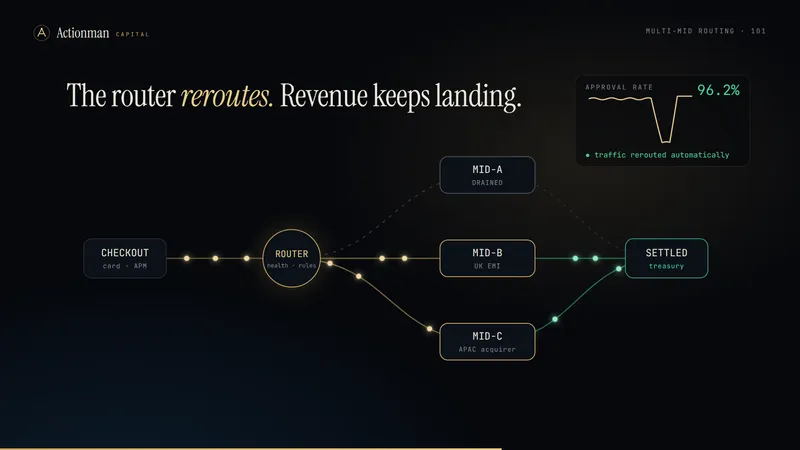
High-Risk Merchant Accounts: How Multi-MID Routing Keeps You Processing
A high-risk merchant account is one decision away from zero. How multi-MID routing and failover work, the 2026 VAMP and retry rules a router must respect, why setups still fail, and where resilience ends and MID stacking begins.
Payment Orchestration Platform Guide for High-Risk Merchants
How a payment orchestration platform routes, cascades and fails over across multiple acquirers, what it can and cannot fix for high-risk merchants, and a practical checklist for choosing one.