
MATCH List: Reason Codes, the 5-Year Rule and How Removal Works
A Mastercard MATCH listing lasts five years and only the listing acquirer can remove it early. The reason codes, how to find out why you were listed, and the removal routes that actually work.
The MATCH list is Mastercard's database of merchants whose card processing was terminated by an acquirer for specific reasons: excessive chargebacks, fraud, PCI DSS failures, laundering and other serious rule breaches. Acquirers are required to check it before they approve a merchant, so a listing makes it very hard to open a new merchant account anywhere.
Here is the short answer most people are searching for. A MATCH listing stays for five years, and only the acquirer that added you can remove it early. Under Mastercard's rules there are two grounds for early removal: the acquirer listed you in error, or you were listed for PCI DSS non-compliance (reason code 12) and have since become compliant. Having brought your chargebacks down since then is not grounds for removal.
That sounds final, and for many listings it is. But a surprising number of listings contain errors, list the wrong people, or use the wrong reason code, and those can be corrected. This guide explains how MATCH works, how to find out why you were listed, which removal routes are real, and why the workarounds people suggest make things worse.
What the MATCH list is (and what "TMF" means)
MATCH stands for Member Alert to Control High-Risk Merchants. It's often called the terminated merchant file (TMF), a generic industry term for the blacklists card schemes run. Visa operates its own equivalent, the Visa Merchant Screening Service (VMSS).
Mastercard runs the database, but it doesn't decide who goes on it. Acquirers do. When an acquirer terminates a merchant agreement, it has to check whether the merchant meets any MATCH criteria, and if it does, report the merchant. Per processor documentation of Mastercard's rules, that report is due within one business day of the termination or of the merchant becoming eligible.
A listing records both the business and the people behind it, including:
- Business legal name, trading name (DBA), address, phone, tax ID and website
- Principal owners' names, addresses, phone numbers and tax IDs
- Account opening and termination dates
- The MATCH reason code
That second group is the part founders miss. MATCH follows the principals, not just the company. Closing the company doesn't close the listing.
MATCH reason codes explained
Mastercard uses 13 reason codes (code 06 is currently unused). Two are quantitative, meaning a merchant qualifies by crossing numeric thresholds. The rest are qualitative.
Code | Reason | What it means |
|---|---|---|
01 | Account data compromise | Unauthorized access to or disclosure of cardholder data at the merchant |
02 | Common point of purchase | Card data stolen at the merchant and used for fraud elsewhere |
03 | Laundering | The merchant submitted transactions that weren't genuine sales between it and a real cardholder, for example processing for another business |
04 | Excessive chargebacks | Quantitative, see below |
05 | Excessive fraud | Quantitative, see below |
07 | Fraud conviction | A principal owner or partner was convicted of criminal fraud |
08 | Questionable Merchant Audit Program | Identified under Mastercard's questionable merchant criteria |
09 | Bankruptcy, liquidation, insolvency | The merchant can't, or is likely unable to, meet its financial obligations |
10 | Violation of standards | Breach of Mastercard merchant standards, such as prohibited transactions or improper surcharging |
11 | Merchant collusion | Participation in fraudulent collusive activity |
12 | PCI DSS non-compliance | Failure to comply with the Payment Card Industry Data Security Standard |
13 | Illegal transactions | Processing unlawful transactions |
14 | Identity theft | The acquirer believes the merchant's or principals' identity was unlawfully assumed to open the account |
The quantitative codes: 04 and 05
As of 2026, processor documentation of Mastercard's rules sets these criteria:
- Code 04, excessive chargebacks: Mastercard chargebacks in a single month exceed 1% of Mastercard sales transactions in that month, and total USD 5,000 or more.
- Code 05, excessive fraud: fraud-to-sales dollar volume of 8% or more in a month, with 10 or more fraudulent transactions totaling USD 5,000 or more.
Two points that surprise merchants:
- The bar is far lower than the monitoring programs. Mastercard's Excessive Chargeback Program starts at 1.5% and 100 chargebacks. The MATCH chargeback criterion is 1% and USD 5,000 with no minimum count. A small merchant can qualify for code 04 after a single bad month. (Our guide to chargeback ratio thresholds under Visa VAMP and Mastercard covers the monitoring side.)
- Winning the chargebacks later doesn't undo it. Qualification is based on chargebacks received in the month, not on their outcome.
Meeting the criteria doesn't list you automatically. A listing follows a termination. But once an acquirer terminates a merchant that meets the criteria, it's expected to report, and closing the account yourself doesn't prevent that.
How long you stay on MATCH
Five years from the listing, whatever the reason code. After that, the entry ages off automatically. You don't need to apply for removal.
Two things can extend the practical impact:
- A new listing by another acquirer starts its own five-year period.
- Acquirers keep their own internal records and may still ask about past terminations after the entry has expired. Answer honestly.
Visa's VMSS also keeps listings for five years, and an acquirer may report to both. Check both.
How to find out if you're on MATCH, and why
Merchants can't search MATCH themselves. Only acquirers can query it. Your options:
- Ask the acquirer that terminated you. Request, in writing, whether you were reported to MATCH or VMSS, the reason code, the listing date and the names and details reported.
- Ask a prospective acquirer. If an application is declined on a MATCH hit, ask which acquirer listed you and under which code. Many will tell you.
- Contact Mastercard. Stripe's documentation notes that a merchant who doesn't know which acquirer listed it can email Mastercard at matchbusinessowner@mastercard.com to request the listing details.
- Use data access rights where they apply. In jurisdictions with data protection laws, principals may have a right to request personal data an acquirer holds and has shared about them. Take local legal advice on how that applies.
Get everything in writing. You'll need it for every step that follows.
How to get off the MATCH list: the legitimate routes
There are three outcomes worth pursuing: removal, correction and a well-documented application while listed. Which one fits depends on the facts.
1. Removal for acquirer error
If the acquirer listed you when you didn't meet the criteria, it can remove the entry. Common errors worth checking:
- Wrong numbers. The acquirer counted chargebacks across all schemes, used the wrong month, or included chargebacks that were duplicates or reversals of processing errors. Code 04 is based on Mastercard activity only.
- Wrong entity or wrong people. A related company, a former director who had left before the relevant period, or a person who was never a principal.
- Wrong reason code. An account closed for commercial reasons, or for the acquirer's change in risk appetite, recorded as a violation.
- No qualifying termination. You ended the relationship yourself and never met the criteria.
Build a file with your statements, chargeback reports by scheme and month, your merchant agreement, and the termination notice. Show exactly why the criteria weren't met, and ask the acquirer to submit a correction or deletion. Be precise and unemotional. The person who reviews it has to justify a change to Mastercard.
2. Removal after PCI DSS remediation (code 12)
Code 12 is the only code designed to be cured. If you were listed for PCI DSS non-compliance:
- Complete a current PCI DSS assessment at the level your acquirer requires. That means a Self-Assessment Questionnaire or a Report on Compliance, with a qualified assessor where needed.
- Close the findings, and where a data compromise was involved, complete any required forensic investigation.
- Send the evidence to the listing acquirer and request removal.
Removal is still at the acquirer's discretion. A complete, current file makes it an easy yes.
3. Correcting details and resolving disputes
Even where a listing stands, the details must be accurate. You can ask the acquirer to fix:
- Principals listed who shouldn't be
- Wrong addresses, tax IDs or business names that cause false matches for unrelated people or companies
- A reason code that overstates what happened, for example a fraud code where the file shows a chargeback problem
Also resolve anything the acquirer is still owed. An unpaid balance or open dispute with the terminating acquirer won't help your case and will come up in any future application.
4. When you can't get removed: applying while listed
For a correctly recorded code 04 or 05 listing, there's no early removal route. Waiting out the five years is the rule. What you can do is apply, openly, to acquirers whose risk appetite includes listed merchants. Some high-risk acquirers will consider it, usually with a larger rolling reserve, lower volume caps and closer monitoring.
What helps an application:
- Full disclosure up front. The acquirer will find the listing anyway. Raising it first changes the conversation.
- A root-cause explanation. What drove the chargebacks or fraud, with the data.
- Evidence of change. New descriptors, refund and cancellation policies, fraud tools, 3-D Secure, dispute alerts, and processing history on alternative methods since the listing.
- Realistic projections of volume, ticket size and dispute rate.
For how those accounts are underwritten and structured, see our guide to high-risk merchant accounts and multi-MID routing.
Why re-applying under a new entity or nominee backfires
The most common advice on forums is to form a new company, or put a friend or relative down as owner, and apply again. It's worth being direct about this. It's prohibited, it is usually detected, and it turns a five-year commercial problem into something much more serious.
Why it's prohibited. Merchant applications require accurate disclosure of the business and its beneficial owners, and AML and KYB rules require acquirers to identify who really owns and controls the merchant. Presenting a nominee as the owner to hide the real principal is misrepresentation to a regulated institution. Depending on the jurisdiction, it may also create criminal exposure for the people involved.
Why it's detected. MATCH matching doesn't rely on the company name. Acquirers screen principals, addresses, phone numbers, tax IDs and websites, and compare websites, products, descriptors, bank accounts, devices and IP addresses. The same store with a new company number looks like the same store.
Why it ends worse. When the link is found, the new account is terminated, often with funds held, and it can be reported under reason codes such as 03 (laundering), 10 (violation of standards), 11 (collusion) or 14 (identity theft). Those codes are harder to explain than a chargeback listing. The nominee gets listed too, and their name will be on MATCH for five years. And a later acquirer who learns of the earlier attempt will almost certainly decline an otherwise viable application.
The same applies to running transactions through another merchant's account (transaction laundering) or through a payment facilitator without disclosing the listing. These are the practices MATCH exists to catch.
Avoiding a MATCH listing in the first place
If you're still processing but trending badly, the priority is to act before termination:
- Track Mastercard chargebacks against the code 04 test monthly, not just the monitoring-program thresholds. 1% and USD 5,000 is a much lower bar.
- Talk to your acquirer early. A merchant with a remediation plan is more likely to get time and a managed exit than one that goes quiet.
- Negotiate the exit if it's coming. A termination for commercial reasons, with no criteria met, doesn't require a listing. Get the reason for termination in writing.
- Keep PCI DSS current. Code 12 is avoidable admin.
- Keep banking separate from processing, so a termination doesn't also freeze operating funds. See why business bank accounts get frozen.
How Actionman helps
We help merchants review a MATCH or VMSS listing against the underlying data, prepare correction or removal requests for the listing acquirer, and, where a listing stands, approach acquirers that underwrite listed merchants on full disclosure. We don't help anyone apply through new entities or nominees to get around a listing. If you're facing a termination or a listing, contact us with the reason code and the dates.
Frequently asked questions
Can I still accept payments if I'm on the MATCH list?
Most mainstream acquirers and payment platforms decline MATCH-listed merchants, but some high-risk acquirers will consider a fully disclosed application, usually with a larger reserve and lower volume caps. Alternative payment methods that don't rely on card acquiring may also be available, subject to their own underwriting.
Does the MATCH list affect my personal credit score?
No. MATCH is a card scheme database used by acquirers, not a consumer credit bureau, so it doesn't appear on personal credit reports. It does record principal owners, though, so it can affect future merchant account applications for businesses you own or control.
Is the MATCH list the same as Visa's VMSS?
They serve the same purpose but are separate databases with different reason codes and criteria. Mastercard runs MATCH and Visa runs the Visa Merchant Screening Service (VMSS). An acquirer may report a terminated merchant to one or both, and both keep listings for five years.
Can a lawyer get me removed from the MATCH list?
A lawyer can't remove a listing directly, because only the acquirer that listed you can submit a removal or correction. Legal help can be useful where the listing is factually wrong, the termination breached your contract, or data protection rights apply. For a correctly recorded chargeback or fraud listing, there's generally no early removal route.
Will closing my merchant account before termination keep me off MATCH?
Not if the criteria were met. Processor documentation of Mastercard's rules says acquirers must report merchants that meet MATCH criteria even after the relationship has ended. What does help is fixing the underlying problem early and working with your acquirer before a termination decision.
Sources
- docs.stripe.com · match
- chargebacks911.com · match list
- heartland.us · everything you need to know about the match list
- chargeback.io · what is the tmf match list
- jpmorgan.com · mastercard excessive chargeback program guide
Rails open. Rails close. Know first.
One short email when something actually changes in banking, processing or crypto liquidity. Written by operators, for operators. No fluff, no spam, unsubscribe in one click.
Chargeback Ratio Thresholds: Visa VAMP and Mastercard Rules for 2026
Visa's VAMP threshold dropped to 1.5% in April 2026, and Mastercard still flags merchants at 100 chargebacks and 1.5%. How each ratio is calculated, what it costs, and how to bring it down legitimately.
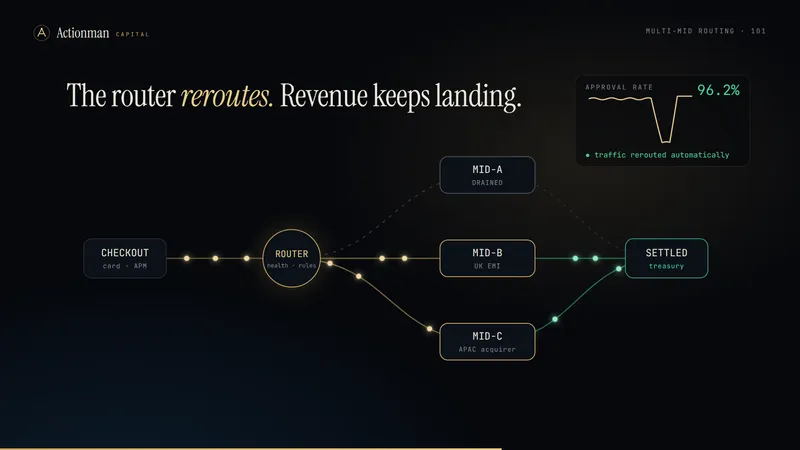
High-Risk Merchant Accounts: How Multi-MID Routing Keeps You Processing
A high-risk merchant account is one decision away from zero. How multi-MID routing and failover work, the 2026 VAMP and retry rules a router must respect, why setups still fail, and where resilience ends and MID stacking begins.
Business Bank Account Frozen? Causes, First Steps and Prevention
Why banks freeze business accounts, how to tell a compliance review from de-risking or a legal hold, what to do in the first 48 hours, and how to structure treasury so one freeze isn't fatal.