
Merchant of Record vs Payment Facilitator: Liability, Tax and Fit
A merchant of record takes over the sale, including chargebacks and VAT; a payment facilitator only takes over the plumbing. How MoR, PayFac and direct merchant accounts compare, and when each fits.
A merchant of record (MoR) is the legal entity that sells to your customer. Its name appears on the card statement, it takes the payment, and it carries the liabilities that come with being the seller: chargebacks, refunds, fraud losses, consumer-law obligations, and collecting and remitting sales tax or VAT. When you use an MoR, the MoR buys the right to resell your product and you receive a payout, minus its fee.
A payment facilitator (PayFac) is different. It onboards you as a sub-merchant under its own master merchant account, so you can take card payments quickly without your own merchant account. But you remain the seller. The sale, the tax and the customer relationship stay yours, and chargebacks come back to you.
So the short answer: an MoR takes over the sale; a PayFac only takes over the plumbing. This guide explains how each model works, who is liable for what, how both compare with a direct merchant account, and when each one makes sense, especially for cross-border and high-risk businesses.
What a merchant of record actually is
Card schemes don't use the phrase "merchant of record" as a formal category. They define a merchant functionally. Visa, for example, describes a merchant as the entity that sells goods or services to cardholders under its own brand, records the sale as revenue rather than a commission, provides customer service and handles returns. Whoever meets that test is the seller for card-scheme purposes.
An MoR business is built on meeting that test on your behalf. In practice, an MoR:
- Contracts with the customer under its own terms of sale, with your product as the thing sold.
- Appears on the statement descriptor, often alongside your brand.
- Holds the merchant account with its acquirers and absorbs dispute liability toward them.
- Handles indirect tax: registering, charging, filing and remitting VAT, GST or sales tax in the countries where your customers are.
- Carries consumer-law obligations such as refund rights and invoicing rules in each market.
- Pays you out, usually on a set schedule, net of its fee and sometimes a reserve.
The MoR model is most common for software, SaaS, digital goods, games and online courses, where one entity can plausibly be the reseller of a product delivered electronically.
The tax reason MoRs exist
The main commercial driver is indirect tax. Since 2015, B2C sales of electronically supplied services into the EU have been taxed where the customer is, and since 1 July 2021 the EU's One Stop Shop (OSS) lets a seller report that VAT through a single registration. That is a real simplification, but you still have to calculate, collect and file correctly across 27 member states, plus the UK, Norway, Switzerland, Australia and many others that apply similar rules.
In the US, marketplace facilitator laws in all states that levy a statewide sales tax (plus DC and Puerto Rico, as of 2026) push collection onto platforms that facilitate third-party sales. And under the EU's VAT rules, a platform that takes part in supplying electronic services is presumed to be acting in its own name, and is therefore treated as the supplier, unless strict conditions identify the underlying provider as the seller. An operator that authorizes the charge or sets the general terms cannot shift that status. A 2025 Court of Justice ruling (Xyrality, C-101/24) confirmed that platforms can be treated as the supplier for VAT depending on the actual contractual set-up, not just on what their receipts say.
An MoR takes all of that off your desk because, legally, it is the seller. The precise tax outcome depends on your products and markets, so confirm it with a tax adviser before you rely on it.
What a payment facilitator is
A PayFac is a registered entity, sponsored by an acquirer, that signs up sub-merchants under its own master merchant account and receives settlement from the acquirer on their behalf. Stripe, PayPal, Square and many vertical software platforms operate this way. The appeal is speed: onboarding in minutes or days, instead of the weeks a full merchant account application takes.
What matters is where the liabilities sit:
- You are still the merchant. Your business name is on the descriptor, your terms apply to the sale, and your tax obligations are unchanged.
- Chargebacks flow back to you. The PayFac is financially liable to its acquirer for sub-merchant transactions, so it passes disputes and losses down to you contractually, and it can hold funds, set reserves or close your account to protect itself.
- The acquirer sits at the top. Visa's rules make the acquirer responsible for the acts of both the PayFac and its sponsored merchants. That is why PayFacs underwrite, monitor and shut down sub-merchants aggressively when risk rises.
- You can outgrow it. Scheme rules require larger sub-merchants to have a direct agreement with the acquirer. Visa's threshold, as of its 2024 guidance, is US$1 million in annual Visa sales volume. Mastercard sets its own threshold and exceptions, so check current rules.
Most PayFacs publish restricted and prohibited business lists. High-risk verticals are frequently excluded, and sub-merchant accounts are the easiest accounts in payments to close.
Merchant of record vs payment facilitator vs direct merchant account
Here is how the three models compare on the points that usually decide the choice.
| Merchant of record | Payment facilitator (sub-merchant) | Direct merchant account |
|---|---|---|---|
Who is the seller | The MoR | You | You |
Whose name is on the card statement | The MoR's (often with your brand) | Yours | Yours |
Merchant account held by | The MoR | The PayFac (master account); you are a sub-merchant | You, with the acquirer |
Chargeback liability | MoR carries it toward its acquirer; contract may pass some costs back | You, via the PayFac | You, directly |
Sales tax / VAT collection and filing | MoR | You | You |
Fraud losses | MoR, subject to contract | You | You |
Onboarding speed | Days to weeks | Minutes to days | Weeks to months, longer for high-risk |
Typical cost | Highest, a bundled percentage covering payments, tax and compliance | Moderate, standardized pricing | Lowest at scale, negotiated |
Control over checkout, routing and data | Lowest | Moderate | Highest |
Customer relationship | Shared; the MoR contracts with the buyer | Yours | Yours |
Fits high-risk verticals | Rarely; most MoRs are selective | Rarely; restricted lists apply | Yes, with specialist acquirers |
Account termination risk | MoR can offboard you | Highest; sub-merchants are easy to close | Lower, but reserves and monitoring apply |
Pricing varies widely by provider and volume, so treat the cost row as directional, not a quote.
Who is liable for chargebacks and sales tax: the details that matter
The table simplifies. In the contracts, a few points deserve close reading.
Chargebacks under an MoR. The MoR is liable toward its acquirer, but most MoR agreements let it recover some dispute costs from you, set reserves, or terminate you if your dispute rate climbs. Transfer of liability is real, but it is not unconditional.
Chargebacks under a PayFac. Liability runs sub-merchant to PayFac to acquirer, and the scheme debits the acquirer. In practice you pay first. Expect rolling reserves or delayed payouts if your ratios move.
Tax under a PayFac or direct account. Nothing changes: you are the seller, so registration thresholds, invoicing and remittance are yours in every market where you owe tax.
Tax under an MoR. The MoR handles the tax on its sale to the customer. You still have your own corporate tax position on the payouts you receive, and possibly obligations on the supply from you to the MoR. That is a question for your tax adviser, not your payments provider.
Refunds and consumer rights. An MoR usually controls the refund policy because it bears the consequences. If your model relies on generous or unusual refund terms, check they survive the MoR's standard terms.
When to use a merchant of record
An MoR tends to make sense when:
- You sell software, SaaS or digital products to consumers in many countries and don't want to register and file for indirect tax in each of them.
- You are small or early, with no finance team to run global tax compliance.
- You want one contract instead of a stack of payment provider, tax engine, fraud tool and invoicing system.
- Your dispute rates are low and stable. MoRs underwrite you as a supplier and will leave if your product creates disputes.
It makes less sense when:
- Margins are thin. The bundled fee is the price of the liabilities the MoR takes on.
- You need control over checkout, routing across acquirers, retry logic or descriptors.
- You sell physical goods, services delivered in person, or regulated products, which many MoRs don't support.
- You are in a high-risk vertical. iGaming, nutra, adult, forex and similar categories are generally outside MoR appetite.
One more consideration: concentration risk. When you use an MoR, your revenue is the MoR's revenue until it pays you out. In early 2025, Digital River, a long-established MoR, announced it was winding down, after reports that some merchants on its MyCommerce platform had gone unpaid for months. Check an MoR's payout frequency, reserve terms, financial standing and what happens to funds in transit if it fails, and keep a fallback.
When a PayFac or direct merchant account is the better fit
Choose a PayFac when you are a low-risk business that needs to take payments quickly, sells mostly domestically, or is comfortable managing its own tax. PayFacs are also the model for platforms that want to embed payments for their own users: a software company can become a PayFac, or partner with a PayFac-as-a-service provider, to onboard its customers as sub-merchants.
Choose a direct merchant account when you are high-risk, high-volume, or both. A direct relationship with an acquirer, or several, gives you negotiated pricing, your own descriptor, and the ability to run multiple routes behind an orchestration layer. For high-risk merchants it is usually the only realistic option. Our guides on high-risk merchant accounts and multi-MID routing and payment orchestration for high-risk merchants cover how to build that properly.
Many businesses move through all three: MoR or PayFac at launch, then direct merchant accounts once volume, tax infrastructure and processing history justify it.
MoR misuse and transaction laundering: where the line sits
"Merchant of record" is also a phrase used by operators offering something else entirely: processing your transactions through their merchant account, under their business description, without being a registered PayFac or genuinely reselling your product. Sometimes it is pitched as a way for a high-risk business to "borrow" a low-risk MID.
That is transaction laundering (also called factoring or undisclosed aggregation). Card schemes prohibit it, acquirers screen for it with web crawlers and transaction monitoring, and when it is found the account is terminated, funds are held, and the business and its principals can be added to Mastercard's MATCH list. See how MATCH listings and removal work.
A legitimate MoR:
- Contracts with your customers openly, under its own name and terms.
- Discloses your product and category to its acquirers.
- Handles tax as the seller of record.
- Underwrites you before accepting you, and can explain its acquiring set-up.
If the offer is simply "we'll process your volume under our company" with none of the above, it is not an MoR arrangement. It is a way to lose your funds and your ability to process. Legitimate chargeback exposure is managed at the source instead: see our guide to Visa VAMP and Mastercard chargeback thresholds.
Choosing a model: questions to answer first
Before you sign with anyone, get clear answers to these:
- What do I sell, to whom, and where? Digital vs physical, B2C vs B2B, and which countries.
- Where do I already owe tax, and where would I need to register? Get professional advice on your specific markets.
- What is my dispute and refund profile? This decides who will take you.
- How much control do I need over checkout, descriptors, routing and customer data?
- What happens to my funds if the provider terminates me or fails? Payout schedule, reserve terms, notice periods.
- Can I export my customers and stored payment credentials if I leave?
- Which entity will contract and receive payouts? Your corporate structure and banking need to match the model.
How Actionman helps
We help international operators choose between MoR, PayFac and direct acquiring, and build the structure behind that choice: the contracting entity, the banking that receives payouts or settlement, and introductions to acquirers and providers that fit the vertical. We work only with arrangements that disclose the real business. If you are deciding which model fits, contact us with what you sell, your markets and your monthly volume.
Frequently asked questions
Is Stripe a merchant of record?
Stripe's core payments product operates on a payment facilitator model: your business is the seller and remains responsible for taxes and disputes. Providers increasingly offer both models under different products, so check which product and contract you are actually signing and who is named as the seller.
Does using a merchant of record mean I pay no VAT or sales tax?
No. The MoR collects and remits the indirect tax on its sale to the end customer, so the tax is still paid, just not by you directly. You still have your own corporate income tax position on payouts, and possibly tax considerations on your supply to the MoR, which a tax adviser should review.
Can a high-risk business use a merchant of record?
Rarely. Most MoRs focus on software and digital goods and exclude categories such as gambling, adult content, nutraceuticals and forex. High-risk businesses usually need direct merchant accounts with specialist acquirers instead.
What is the difference between a PayFac and an ISO?
An ISO (independent sales organization) refers merchants to an acquirer, and each merchant gets its own merchant account with that acquirer. A PayFac boards sub-merchants under its own master account, receives settlement on their behalf and takes on financial liability for them toward the acquirer.
Can I switch from a merchant of record to my own merchant account later?
Yes, many businesses do once volume and tax infrastructure justify it. Plan for tax registrations in your markets, a new acquirer application, and migrating stored payment credentials and subscriptions, and check your MoR contract for notice periods and data export terms first.
Sources
- usa.visa.com · visa acceptance entities
- usa.visa.com · visa payment facilitator model
- stripe.com · merchant of record vs payment facilitator
- wiki.private.law · payfac vs iso
- legislation.gov.uk · data
- bakermckenzie.com · european union cjeu judgment clarifies vat article 28 scope
- vid.gov.lv · vat e commerce special scheme oss
- emplicit.co · marketplace tax collection state by state guide
- fintechfutures.com · us paytech digital river reportedly shutting down
Rails open. Rails close. Know first.
One short email when something actually changes in banking, processing or crypto liquidity. Written by operators, for operators. No fluff, no spam, unsubscribe in one click.
Payment Orchestration Platform Guide for High-Risk Merchants
How a payment orchestration platform routes, cascades and fails over across multiple acquirers, what it can and cannot fix for high-risk merchants, and a practical checklist for choosing one.
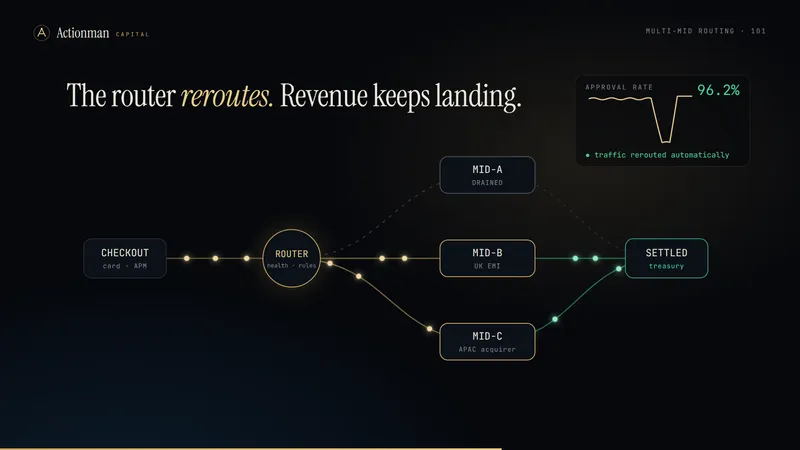
High-Risk Merchant Accounts: How Multi-MID Routing Keeps You Processing
A high-risk merchant account is one decision away from zero. How multi-MID routing and failover work, the 2026 VAMP and retry rules a router must respect, why setups still fail, and where resilience ends and MID stacking begins.
MATCH List: Reason Codes, the 5-Year Rule and How Removal Works
A Mastercard MATCH listing lasts five years and only the listing acquirer can remove it early. The reason codes, how to find out why you were listed, and the removal routes that actually work.