
Brazil Betting Ban 2026: What It Means for Payments
MP 1,394 bans fixed-odds betting in Brazil and bars banks, Pix and card schemes from processing it. Licences end 25 October. What operators, affiliates and PSPs must do now, and why Brazil-heavy merchants are being re-underwritten.
Brazil no longer has a licensed online betting market. Provisional Measure (MP) 1,394, in force since 25 September 2026, bans the operation, offering, intermediation and advertising of fixed-odds betting, which covers sportsbook and online casino games. It also bans banks, payment institutions, Pix participants and card schemes from processing payments for it. Licensed sites went dark on 6 October, banks refunded player balances from 9 to 14 October, and every federal authorisation is extinguished on 25 October. The R$30 million licence fees are not refunded.
What that means for money: any payment into a betting operator from Brazil is now a prohibited flow, whoever the operator is and wherever it is licensed. If you run, market or process for iGaming with Brazilian volume, stop new Brazilian deposits, close out the refund and record-keeping duties to the letter, and tell your acquirer and bank what your Brazil exposure was before their monitoring tells them.
Below: the MP, the payment rules that enforce it, what changes for operators, affiliates and PSPs, why Brazil-heavy merchants are being re-underwritten, what could still change, and where licensed LatAm volume can go. Current as of 20 October 2026; not legal advice. We don't help anyone keep serving Brazilian players.
What the Brazil betting ban does
MP 1,394 was published and took effect on 25 September 2026. It revokes most of Law 14.790/2023, the law that created Brazil's licensed betting regime. The key points:
- Scope. The ban covers fixed-odds bets on real sporting events and on online games. It also ends betting authorisations granted by states and the Federal District. Other lottery products provided for by law are not affected.
- Foreign operators are covered. The Senate's own summary says the ban applies to foreign companies offering bets to people in Brazil. An offshore licence doesn't take you outside it.
- Licences end. Existing authorisations are extinguished 30 days after publication, on 25 October 2026, with no refund of the grant fee and no compensation (art. 4). Agência Brasil counted 85 paid authorisations at R$30 million each; the Finance Ministry's Prizes and Betting Secretariat (SPA) listed 87 authorised operators on 1 July 2026. New applications are barred and pending ones are void.
- Advertising. All advertising, marketing and sponsorship aimed at Brazilians is banned in any medium (art. 16). Existing ads had to come down within 10 days. Platforms and app stores must remove betting content when notified, or face fines of up to 10% of the group's Brazilian revenue (art. 22).
- Obligations survive. Closing down doesn't end tax, regulatory, AML, responsible gambling or integrity duties for the period you were authorised. Records on bettors, bets, payments and prizes must be kept for at least five years and reported to the SPA through its Sigap system (arts. 10–11).
The wind-down ran on a fixed timetable:
Date (2026) | What happened |
|---|---|
25 Sep | MP published and in force; no new deposits into operator transaction accounts |
28 Sep–2 Oct | Central Bank resolutions extend the block to all payment rails |
5 Oct, 23:59 | Last day for players to withdraw voluntarily; ads and sponsorship signs removed |
6 Oct | Sites and apps offline, including app store listings |
7–8 Oct | Operators send each player's CPF, balance and source account to the player's bank, and the same data to the SPA with proof of funds |
9–14 Oct | Banks refund players to an account in their own name |
From 14 Oct | Unrefunded amounts go to a dedicated Caixa Econômica Federal account supervised by the Finance Ministry |
25 Oct | All federal and state authorisations extinguished |
About R$1.325 billion was left on platforms for roughly 26.5 million bettors as of 6 October, and about 40 CPFs with unusually large balances are being examined for possible money laundering. Operators that failed to fund refunds face a daily fine of R$200,000 (art. 8).
The payment rules: what banks, PSPs and acquirers must now block
This is the part that reaches far beyond betting operators. Article 14 says financial institutions, payment institutions, payment scheme operators and every other scheme participant, including instant payment schemes, may not process, settle or enable any transaction destined for fixed-odds betting. The only exception is transactions needed to wind down operations and refund bettors. Scheme operators have to write that into rules binding on all participants, including ones the Central Bank doesn't authorise, and exclude participants who don't comply.
The Central Bank (BCB) implemented it rail by rail within a week:
Rule | Rail | What it says |
|---|---|---|
Resolution BCB 590 (28 Sep) | All payment arrangements | Banks, payment institutions and arrangement participants must stop processing and settling payments to betting operators |
Resolution BCB 595 (30 Sep) | TED | Senders and receivers must prevent transfers to betting, effective from 25 Sep |
Resolution BCB 596 (30 Sep) | Boleto | Blocking duty applies from the MP's publication on 25 Sep |
Resolution BCB 597 (30 Sep, published 2 Oct) | Pix | Participants must prevent the processing, settlement and facilitation of betting transactions, with the wind-down and refund exception |
Two earlier rules now have far more to catch:
- SPA Ordinance 2,750/2026 (published 14 September) tells financial and payment institutions to monitor not only direct payments to unauthorised operators but flows through intermediaries: payment gateways, swapped Pix keys, money moved to other accounts, a legal entity receiving funds that isn't the authorised one. In card arrangements, the duty sits with whoever holds the contract with the receiving merchant, which means acquirers and sub-acquirers. Analysis has to be finished within 45 days of spotting something; on an SPA notice, accounts are blocked within 24 hours, even where the institution holds no account in the target's own name.
- Law 14.790 art. 21-A, as amended by the MP, has institutions report operations linked to an irregular operator to COAF, Brazil's financial intelligence unit. Money in blocked accounts can be forfeited to the federal government in an administrative process, without a prior court case (art. 28).
Enforcement isn't theoretical. Banks and payment institutions closed 323 accounts linked to unlicensed betting in the first quarter of 2026 alone, per Finance Ministry data, flagged by patterns like thousands of short-interval Pix transfers and businesses collecting bettors' money and paying it out to individuals. By 9 October the Justice Ministry had referred 16,627 illegal betting sites for blocking.
Card networks point the same way. Visa treats gambling (MCC 7995) as Tier 1 High Integrity Risk: acquirers need separate approval and every merchant must be registered before it transacts. Under card network rules, a transaction that is illegal in the cardholder's or the merchant's jurisdiction is non-compliant, and illegal or miscoded gambling is a textbook brand-damage finding with per-transaction fines. Brazil's card sector had already barred credit cards for online betting in October 2024. From 25 September 2026, a Brazilian card paying a betting merchant is a transaction the acquirer can't defend, wherever that acquirer sits.
What it means for operators
Ex-licensed Brazilian operators. Your licence ends on 25 October, but your obligations don't. Keep the refund reconciliation, the bettor and payment records and the SPA reporting complete for at least five years. Press reports on SPA Ordinance 3,005/2026, which governs the remaining financial, accounting and reporting duties, say some of its deadlines run to 15 December 2026. Segregated player funds can only pay players, and refunds through banks or Caixa don't release you from amounts you got wrong. Don't move operating cash between group entities without a paper trail that matches your SPA filings.
Offshore operators that took Brazilian players. The MP removes any ambiguity: offering bets to people in Brazil is prohibited and every Brazilian payment rail into you is blocked by rule. Geo-block Brazil at signup, deposit and withdrawal, and pay remaining Brazilian balances to accounts in the player's own name. Anything else is the pattern these rules are built to catch, and the fastest route to a termination and a MATCH listing. If that has already happened, our guide to Mastercard MATCH list reason codes and removal sets out what can and can't be done.
Group treasury. Losing Brazil shows up as a volume collapse on processing statements and a sudden change in bank inflows. Both trigger reviews. Write a one-page note now: Brazilian share of group GGR over 12 months, the date you stopped, refund totals and how they reconcile. Hand it over before anyone asks.
What it means for affiliates and white-labels
Advertising aimed at Brazilians is banned in any physical or digital medium, and treated as abusive advertising under the Consumer Protection Code, enforced by consumer authorities. That covers affiliate sites, social content, streams and sponsorships aimed at Brazilian audiences, whoever pays for them. Content published before the MP that only incidentally shows betting ads is exempt (art. 17).
In practice: take down or geo-restrict Brazilian-facing pages and campaigns, stop routing Brazilian traffic to any operator, and keep records showing when the traffic stopped.
White-label and B2B providers get the same questions from their banks: any receipts linked to a Brazilian brand after 6 October need an explanation that fits the refund timetable.
What it means for PSPs, gateways and EMIs with Brazilian volume
If you are a Brazilian payment institution, sub-acquirer, Pix gateway or a foreign PSP with Brazilian collection rails, your duty is now to block, not to check whether the operator was licensed. In practice:
- Merchant book review. Every merchant whose Brazilian flows look like betting needs a review, not only MCC 7995 merchants. Ordinance 2,750 names the patterns: receipts by an entity other than the one authorised, Pix key swaps, funds passed through intermediaries. A "payment gateway" merchant with many low-value Pix collections from individuals and payouts to individuals is the profile banks are told to look for.
- Upstream pressure. Your sponsor bank or BCB-authorised partner carries the scheme-rule and COAF exposure. Expect requests for your Brazilian merchant list, MCC mix and evidence of blocking controls. Arrangement operators must exclude participants that don't comply.
- Volume cliff. Betting Pix and boleto volume has gone, and a sudden recovery in "other" Brazilian collections is exactly what monitoring looks for.
Why Brazil-heavy merchants are being re-underwritten
Expect a review if more than a token share of your volume is Brazilian, even if you never touched betting. Risk teams are asking where Brazilian betting money went after 6 October. Some of it will try to move through anything that takes Pix or Brazilian cards: digital goods, top-ups, "gaming credits", gift cards, crypto on-ramps, P2P. Those are the merchants that get looked at.
What triggers the request for information:
- A jump in Brazilian volume after 25 September with no marketing change to explain it.
- Many small Pix or card payments from individuals, followed by payouts to individuals.
- Descriptors, websites or support pages that mention odds, bonuses or wagering.
- Crypto purchases with Brazilian cards or Pix funding settled to wallets you can't tie to the customer. Brazil's separate crypto rules, covered in our guide to Brazil's 2026 crypto off-ramp rules, add their own reporting on top.
What closes a review quickly: a product description that matches your MCC, 12 months of Brazilian volume by month with any change explained, customer-level evidence (KYC, delivery or usage logs), and your controls for spotting betting payments. An acquirer that still wants protection usually asks for a higher reserve rather than terminating. Model what that does to cash flow with our rolling reserve calculator, and if Brazil was a big share of approvals, spread processing across more than one acquirer so a single review can't stop your whole book, as set out in our multi-MID routing guide.
What could still change: the Supreme Court and Congress
The MP applies now, but it isn't final.
- Supreme Court (STF). Justice Luiz Fux is rapporteur on three unconstitutionality actions, including one from betting associations ANJL and IBJR (filed 28 September) and one from broadcasters' association Abert (30 September). Flamengo and other clubs have joined as interested parties. The Attorney General's Office (AGU) defended the measure on 6 October. Reports say Fux will decide only after the presidential runoff on 25 October, the same day the licences end. The lower-court route has also closed for now: on 9 October the president of the federal appeals court in São Paulo (TRF-3) suspended an injunction that had let Stake keep operating until 25 October.
- Congress. A provisional measure lasts 60 days, extendable once by 60, with the clock paused in congressional recess. The joint committee was named on 30 September but hadn't been installed by 14 October; 99 amendments were filed by the 13 October deadline. Reported dates: the MP starts blocking the agenda of the house where it sits from 9 November, and the initial voting deadline is 23 November. If it lapses or is rejected, it loses effect from the start, but the Constitution keeps relations formed while it was in force governed by it unless Congress passes a decree within 60 days.
Don't plan around a reversal. Even if the STF suspended the ban or Congress amended it, licences extinguished on 25 October would need a new legal basis, and banks that have re-papered their betting policies won't reopen quickly. Treat any change as a new market entry.
Where licensed LatAm volume can go
To markets where you hold, or can get, a licence, not to Brazilian players through another door. Each regulated neighbour wants local licensing before banks and acquirers will touch you:
Market | Regulator | What it requires |
|---|---|---|
Peru | MINCETUR | Online regime in force since 9 February 2024 (Law 31557). Peruvian company or branch with a local legal representative, guarantees, certified systems; six-year licences; 12% tax on net income. About 50 licensed operators reported |
Colombia | Coljuegos | Licensed online betting market with a Coljuegos concession contract |
Mexico | SEGOB | Online operation runs under SEGOB gaming permits held by local permit holders |
The sequence that works: licence first, then an acquirer registered for gambling with the networks, MCC 7995 with the licence on file, and a bank account opened against the licence and business plan. A licence elsewhere doesn't make Brazilian players lawful customers, and acquirers see Brazilian BINs and IPs immediately. If you need help building a compliant processing set-up for the markets you are licensed in, that is what our high-risk merchant accounts service does.
What to do this week
- Confirm the block. Brazil geo-blocked at signup, deposit and withdrawal; Brazilian cards, Pix and boleto disabled in your cashier; Brazilian affiliate traffic switched off.
- Close the refund file. Every Brazilian player balance paid to an account in the player's name or reported as transferred to Caixa, reconciled to the SPA submission.
- Lock the records. Five years of bettor, bet, payment and prize data, stored so you can produce it on request.
- Brief your acquirers and banks. One page: Brazilian exposure before 25 September, the date it stopped, refund totals, controls now in place.
- Check your PSP chain. Ask each provider and sub-acquirer in your flow how it is applying Article 14 and Ordinance 2,750 to your account, and what it needs from you.
- Plan the replacement volume in licensed markets only, and expect reserves to be renegotiated rather than released while your volume mix is changing.
- Watch the STF decision after 25 October and the Congress dates of 9 and 23 November.
Frequently asked questions
Is online betting banned in Brazil?
Yes. Provisional Measure 1,394, in force since 25 September 2026, bans the operation, offering, intermediation and advertising of fixed-odds betting, covering sports betting and online casino games. Licensed sites went offline on 6 October and all authorisations are extinguished on 25 October 2026. The Supreme Court and Congress can still change it, but it applies now.
When do Brazilian betting licences end?
On 25 October 2026, 30 days after the MP was published. Operators get no refund of the R$30 million grant fee and no compensation. Their tax, AML, reporting and record-keeping duties for the period they were licensed continue, and records must be kept for at least five years.
Can Brazilians still pay betting sites with Pix?
No. Article 14 of the MP bars banks, payment institutions and all payment scheme participants, including Pix, from processing transactions destined for fixed-odds betting. The Central Bank applied it to every rail: Resolution 590 generally, 595 for TED, 596 for boleto and 597 for Pix. Only wind-down and refund transactions are allowed.
Does the Brazil betting ban apply to offshore operators?
Yes. The Senate's summary of the MP says it applies to foreign companies offering bets to people in Brazil, and every Brazilian payment rail is barred from processing betting transactions. A licence from another jurisdiction doesn't make Brazilian players lawful customers, and card network rules treat a transaction illegal in the cardholder's country as non-compliant.
What happened to bettors' balances after the ban?
Players could withdraw until 5 October. Operators then sent each player's CPF, balance and source account to the player's bank on 7–8 October, and banks refunded them from 9 to 14 October. About R$1.325 billion was owed to roughly 26.5 million bettors as of 6 October; amounts that couldn't be refunded go to a dedicated Caixa account.
Will the Supreme Court overturn Brazil's betting ban?
Unknown. Justice Luiz Fux is handling three challenges, and reports say he will decide only after the 25 October presidential runoff. Congress also has to vote on the MP, with its initial deadline reported as 23 November and one 60-day extension available. Don't plan around a reversal.
Sources
- legis.senado.leg.br · 44061634
- legis.senado.leg.br · 44059160
- www12.senado.leg.br · mp proibe bets e determina encerramento das operacoes em 30 dias
- migalhas.com.br · o fim das bets o que determina a medida provisoria 1 394 2026
- gamblinglawindex.com · brazil bans online betting mp 1394 2026
- finsidersbrasil.com.br · bc proibe pix boleto e ted para bets e cumpre mp assinada por lula
- contadores.cnt.br · resolucao bcb no 597 de 30 09 2026
- mercgroup.com.br · bcb 590 bloqueio pagamentos bets
- csmv.com.br · spa estabelece novas regras de combate as apostas irregulares impact…
- yogonet.com · 10418 o que acontece com o sistema de pagamentos apos a proibicao da…
- forbes.com.br · prazo pra bancos devolverem r 13 bilhao de bets acaba nesta quarta
- tvsaobernardo.com · fim das bets restituicoes avancam e autorizacoes serao extintas aind…
- focusgn.com · instituicoes de pagamento fecham 323 contas de plataformas de aposta…
- igamingbrazil.com · fux deve decidir sobre validade da mp das bets apos o segundo turno …
- focusgn.com · justica derruba decisao que permitia a stake continuar operando no b…
- focusgn.com · congresso recebe 99 emendas a mp que proibe bets no brasil
- lsports.eu · brazil betting ban latam operators
- visa.cl · visa integrity risk program chile
- legitscript.com · BRAM and VIRP Basics Info Sheet
- exame.com · setor de cartoes se antecipa e proibe uso de credito para bets
- sigma.world · peru regula el juego online desde 2024 licencia impuestos y sanciones
- europeangaming.eu · stake launches in mexico via stake mx under segob permit structure
Rails open. Rails close. Know first.
One short email when something actually changes in banking, processing or crypto liquidity. Written by operators, for operators. No fluff, no spam, unsubscribe in one click.
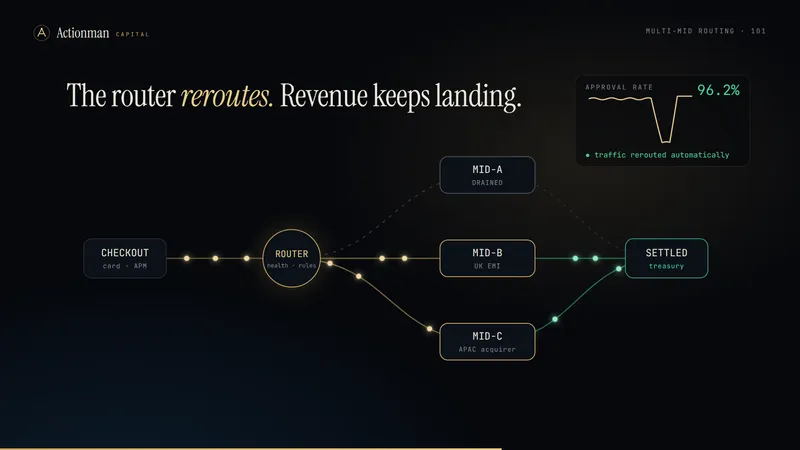
High-Risk Merchant Accounts: How Multi-MID Routing Keeps You Processing
A high-risk merchant account is one decision away from zero. How multi-MID routing and failover work, the 2026 VAMP and retry rules a router must respect, why setups still fail, and where resilience ends and MID stacking begins.
Brazil Crypto Regulation 2026: What Changes for BRL Off-Ramps
From 6 November 2026 Brazilian banks and PSPs can't deal with unauthorised crypto providers. The BCB rules, the US$100k FX cap, US$10k self-custody reporting, Binance's purpose codes, and how to check your counterparties.
MATCH List: Reason Codes, the 5-Year Rule and How Removal Works
A Mastercard MATCH listing lasts five years and only the listing acquirer can remove it early. The reason codes, how to find out why you were listed, and the removal routes that actually work.